
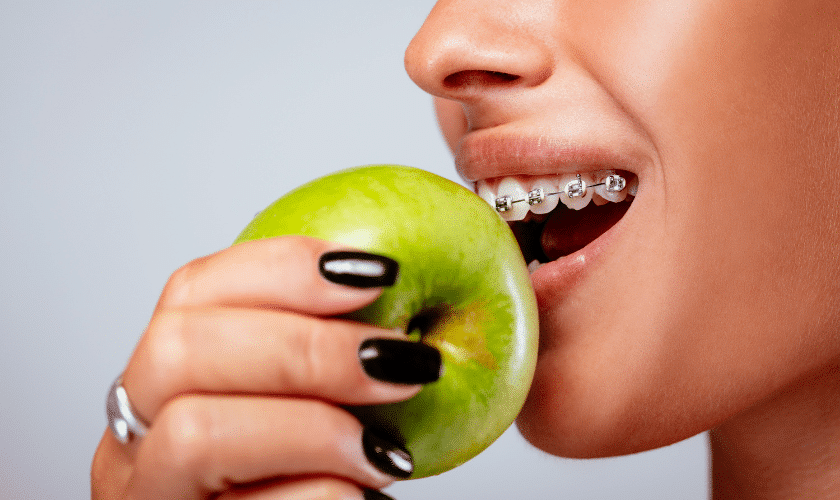
One of the first things patients ask after getting braces in Johns Creek or Brookhaven is what they can still eat. The honest answer is that most foods are fine, but a specific group of foods genuinely causes problems. Broken brackets and bent wires are not just inconvenient. They can extend treatment time by weeks if they go unaddressed or if they happen repeatedly.
Understanding which foods cause damage, and why, makes the restriction easier to follow because it makes sense rather than just being a list of rules.
Why Certain Foods Are Problematic With Braces
Metal braces use brackets bonded to each tooth and wires threaded through them to apply controlled force. The bond between bracket and tooth is strong, but it’s not designed to absorb the kind of stress that comes from biting into hard foods directly. The wires are precisely shaped to guide tooth movement, and bending them out of position disrupts the forces they’re meant to deliver.
When a bracket pops off or a wire bends, the planned movement for that tooth stops or changes. Your next adjustment appointment becomes a repair visit before it can be a progress visit.
The Foods That Cause the Most Problems
Hard foods
Hard foods are the most direct cause of broken brackets. Biting into something hard creates a sudden, concentrated force right at the point where the bracket meets the tooth. That force can exceed the bond strength and pop the bracket off.
The foods that come up most often in orthodontic offices:
- Raw carrots and celery eaten in large bites
- Whole apples and pears bitten into directly
- Hard crusty bread and bagels
- Corn on the cob
- Hard pretzels and crackers
- Nuts of any kind
- Hard candies
- Ice chewing
Most of these aren’t off the menu entirely. Raw carrots can be cut into small pieces. Apples can be sliced. Corn can be cut from the cob. The problem is the direct biting force, not the food itself, in most cases.
Sticky and chewy foods
Sticky foods attach to the brackets and wires and pull on them when chewed or when the food is moved around the mouth. They can also dislodge brackets and are particularly effective at bending wires because the pulling force is sustained rather than sudden.
The most commonly problematic foods in this category:
- Gummy candies of any kind
- Caramel and toffee
- Taffy
- Chewy granola bars
- Bagels with a particularly chewy interior
- Dried fruit, particularly dried mango, dates, and similar
- Fruit snacks and gummies marketed to children
Sticky foods also present an oral hygiene problem because they adhere to the brackets and are hard to clean away, which increases the risk of plaque accumulation and decalcification around the bracket bases.
Crunchy snack foods
Chips, popcorn, and similar snacks occupy an awkward middle category. They’re not as hard as raw vegetables or nuts, but they’re crunchy enough to snap brackets when eaten in quantity, and popcorn in particular carries its own specific hazard.
Popcorn kernels that don’t fully pop are extremely hard and unpredictable. Even patients who are careful about other hard foods sometimes break a bracket on an unpopped kernel that was hidden in a bag of otherwise normal popcorn. The recommendation to avoid popcorn entirely during braces treatment is one of the more consistent pieces of advice for this reason.
Tortilla chips and hard pretzels work similarly. They may seem soft enough to be fine, but repeated chewing across the full duration of treatment adds up.
Sugary foods and drinks
This category is less about mechanical damage and more about what happens to the teeth during treatment. Braces create additional surfaces where plaque can accumulate, and the areas around brackets require more careful cleaning to maintain. High sugar intake during braces treatment significantly increases the risk of white spot lesions, which are areas of enamel demineralization that can appear when the brackets are removed.
Sugary drinks are a particular concern because the liquid reaches every surface of the teeth and brackets. Sports drinks and sodas with high sugar content, consumed regularly during treatment, create conditions that can produce noticeable enamel damage over an 18 to 24-month treatment period.
What to Do When Something Breaks
If a bracket comes off or a wire bends, contact Brookhaven Orthodontics as soon as possible. Don’t wait for your next scheduled appointment unless the office advises it’s fine to do so. A bracket that’s off a tooth is a tooth that isn’t being moved as planned.
If a wire end is poking and causing irritation, orthodontic wax can be placed over the end as a temporary measure. The team at Brookhaven Orthodontics serves patients at two locations, in Brookhaven and Johns Creek, and can advise over the phone about whether a repair needs to be seen immediately or can wait for a scheduled visit.
About Brookhaven Orthodontics
Brookhaven Orthodontics serves patients across Brookhaven, Atlanta, and Johns Creek, GA, with two convenient locations. Dr. Stan Cox and Dr. Kenneth Cohen-Sasson offer metal braces, clear braces, and Spark clear aligners. Complimentary consultations are available with no referral required, and interest-free payment plans are offered. Insurance is accepted at both locations.
Brookhaven: 804 Town Blvd., Suite A2000, Atlanta, GA 30319 Johns Creek: 3440 Old Alabama Road, Suite 200, Johns Creek, GA 30022
Book a Consultation at Brookhaven Orthodontics
If you have questions about braces or want to get started with treatment, Brookhaven Orthodontics offers complimentary consultations at both Georgia locations.
Call or text (404) 343-0677 to book your appointment.
- Schedule a complimentary braces consultation at Brookhaven Orthodontics
- Call us to ask about metal braces in Brookhaven or Johns Creek
- Book your initial consultation at our Brookhaven or Johns Creek location
- Contact Brookhaven Orthodontics with questions about braces care and food restrictions
- Request your free consultation with Dr. Cox or Dr. Cohen-Sasson today

